|
If we can transfer ourselves into bodies of light, we can travel with the speed of light -which is still way too slow for serious space travel. But we can't detach from our atoms yet, so we have to drag our atoms along, atoms that do not want to accelerate.
If we need to transport our atom-based bodies in atom-based spacecrafts, we should learn all there is to learn about atoms, and discover the path of least resistance for the atom's acceleration.
Small
Atoms are extremely small. They can not be viewed using an optical microscope, because they are thousands of times smaller than the wave length of the visible spectrum (380–750 nm). But they can be sensed otherwise (with tiny needle?!), and seem to be round. As the resolution of our instruments improve, we will learn more about the shape of atoms and molecules.
They say that atoms are mainly empty space inside. May we subtract the space of its size, or is space a fundamental part of the atom's structure?
Simple Shape
Smaller often goes together with less complexity. As atoms are very small, their structures are probably very simple. Simple though extremely well organized combinations of just a few primary basic elements. There are different kinds of atoms but the variety isn't endless at all. The periodic table tells me there's only about 102 different kinds of atoms. Two or more atoms can share part of their space and energy and together become what we call molecules, but not all combinations are possible; it has to be a sharing and stable combination.
What shape and structure could atoms have? School books teach us: electrons, protons, neutrons, and even smaller stuff. But this is a logical conclusion based upon what we know so far, we have not really seen it yet.
Ignoring what I have learned, I wonder about the shape and structure of atoms.
- If an atom is a lot of energy in a little space, and
- if energy is motion, a flow of energy traveling with the speed of light, then
How could the structure of an atom be like?
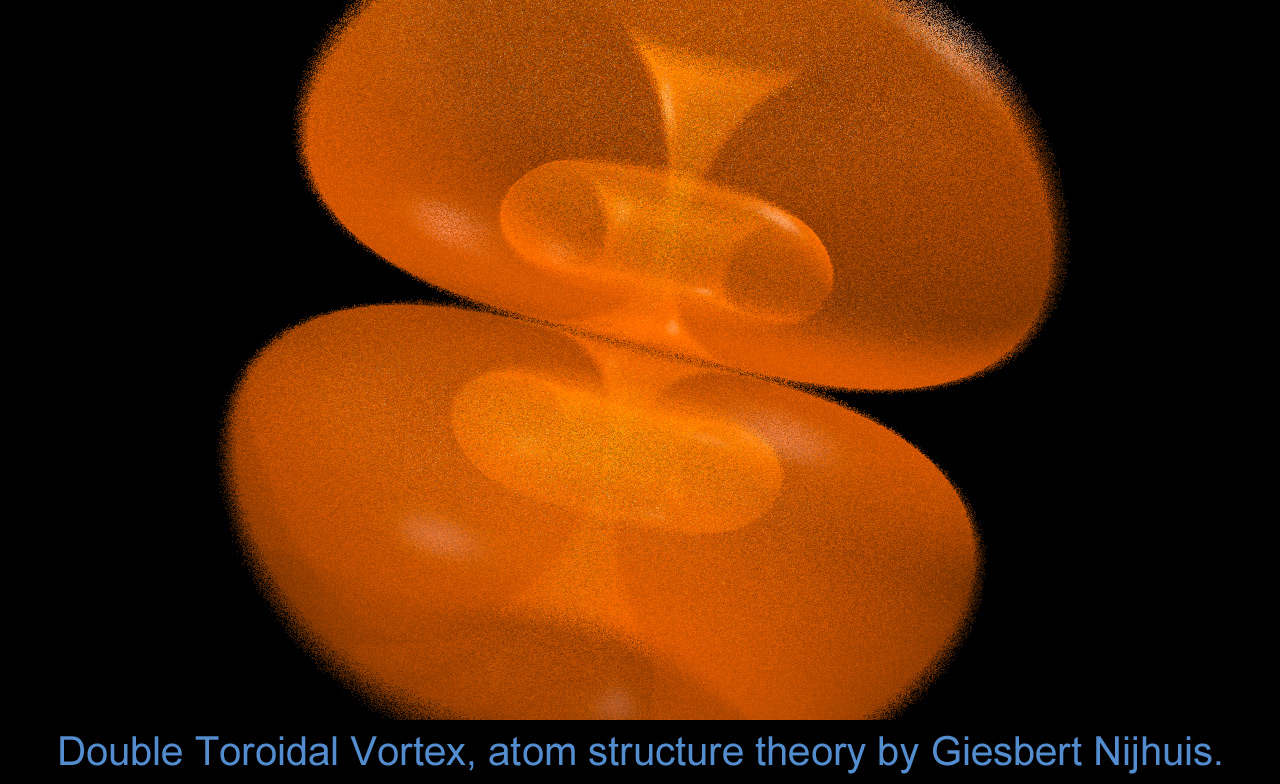
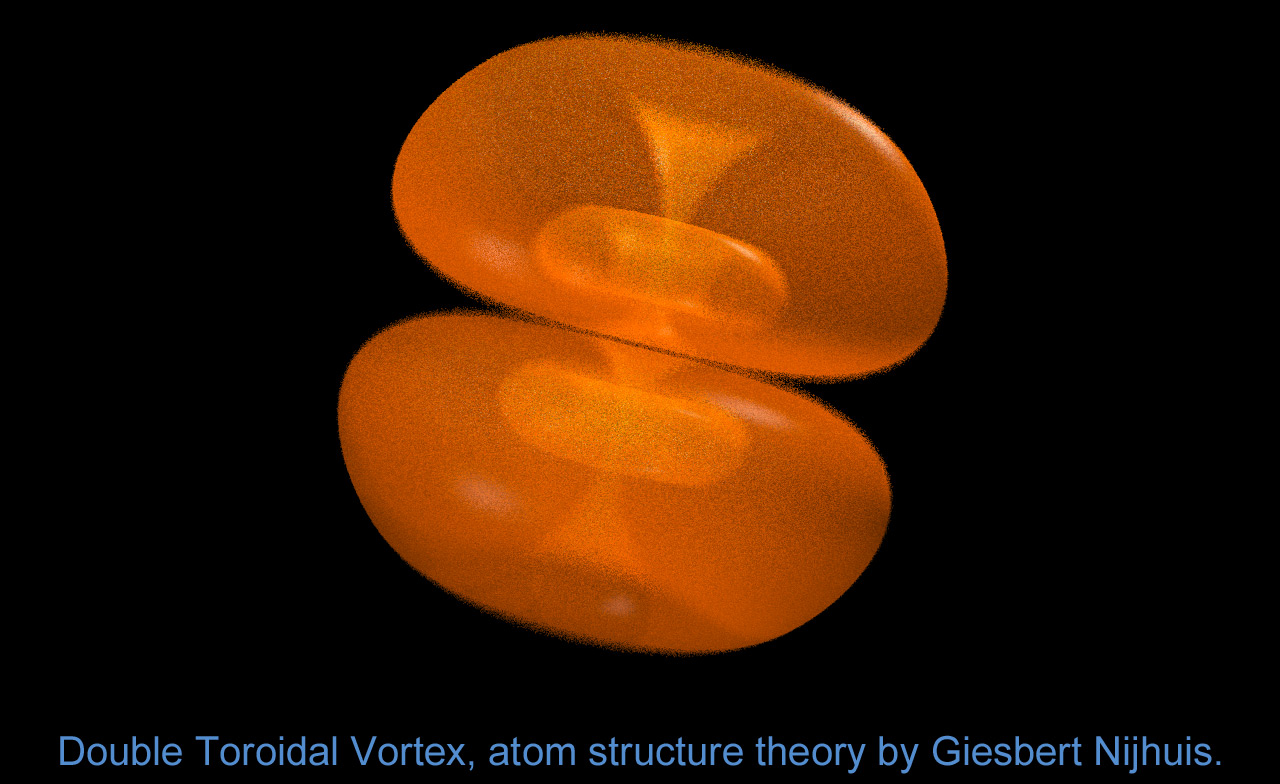
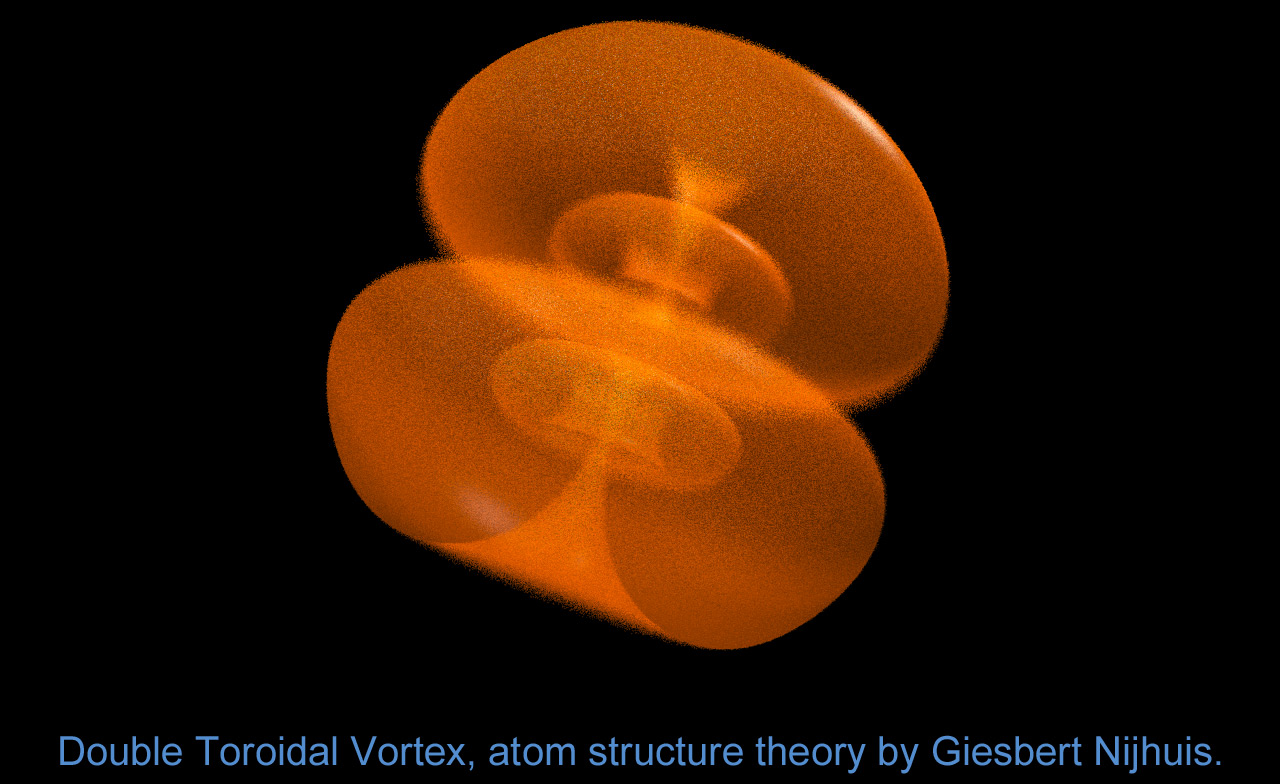
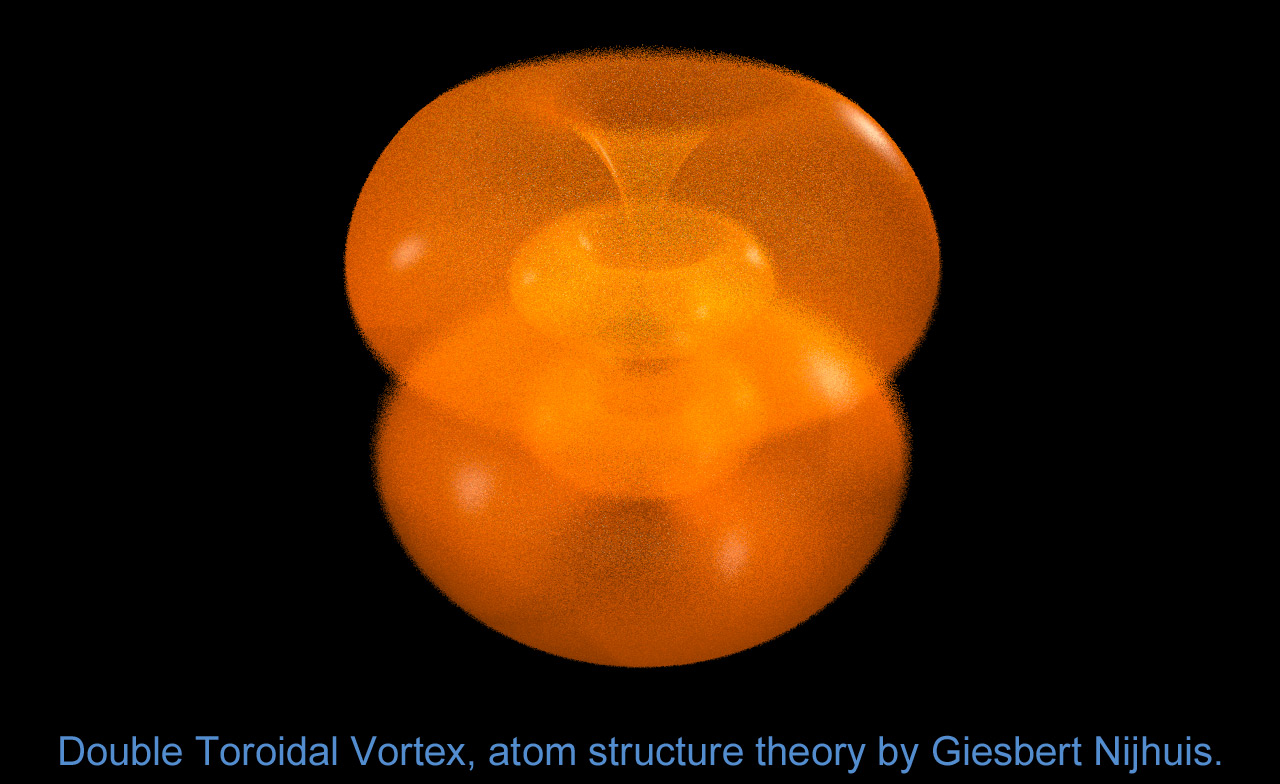
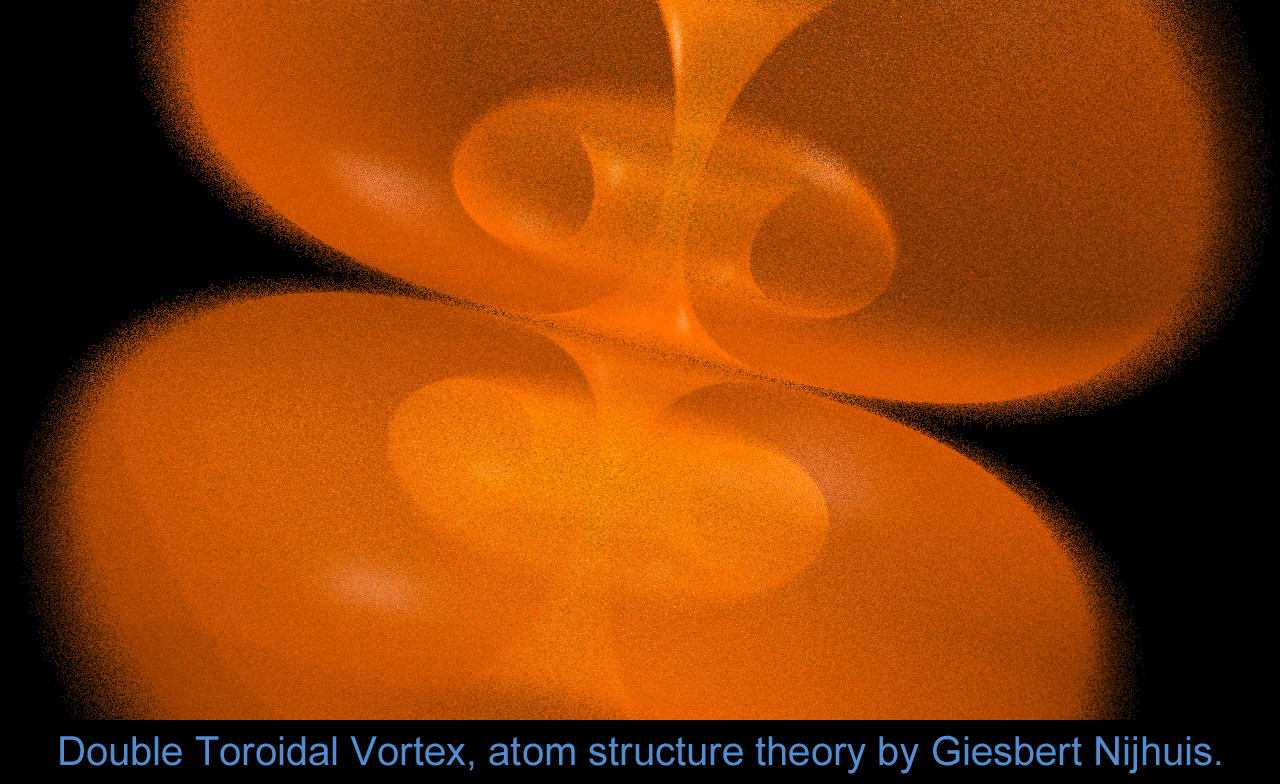
An never ending flow of energy, staying in one location ... first thing that comes in mind is energy traveling around in a circle. But a circle is a 2 dimensional shape, while we have at least 3 dimensions. A 3D energy flow can't be ball shaped. It can be torus shaped. The energy's path of motion could be like a smoke ring, a "toroidal vortex", shaped like a donut.
In the center of a air-vortex (like inside a tornado), is an area of less atmospheric pressure. The higher pressure atmosphere around an air vortex pushes the airflow towards the lower pressured center. Can space be de-compressed similar to the air around us? If not, then what can keep the energy flow going in a circle? An attraction in the center, or a push from around, or is the space-time-fabric inside an atom warped by the energy flows, and the energy actually flowing straight on a warped path?
However it works; I see a torus shape.
But not just one torus, because 1 torus is not in balance. An air ring vortex has two sides: one push side where the flow moves inwards, and one sucktion side where the flow moves outwards. When the two sucktion sides of two toroidal vortex meet, they can stay together, becoming one stable structure.
If this
double toroidal vortex is the basic structure of an atom, then how are all the different kinds of atoms constructed? And molecules? Maybe more complex structures can be made with more than two torus.
Energy & Space
An atom seems to simply be a great lot of energy traveling around inside a tiny part of space. How all that energy stays together I don't know, but it does. The energy can be harvest, though not easily. An atom bomb is a powerful example of how much energy is concentrated inside atoms.
The common idea about vacuum space is that it is a whole lot of empty nothing. Vacuum space is clear of atoms, but I believe it is something. I image space to be some kind of medium at rest.
Mass & Inertia
There is one major problem with building a space ship from atoms: atoms don't want to accelerate! They don't mind having a constant high relative speed, but resist against acceleration in any direction. That we call inertia.
A gyroscope resist gainst turning. A double toroidal vortex is like a multi wheeled gyroscope. I don't know how, but I can image such a dynamic structure giving resistance against acceleration.
|