|
|
|
THE VTOL WING
|
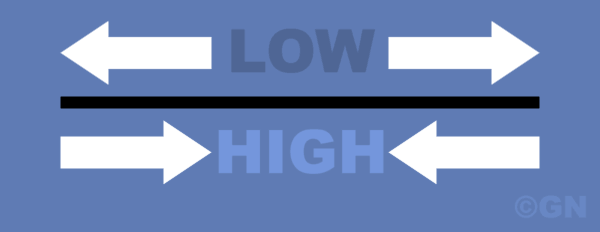
The goal of a wing is to lift an aircraft's weight. Aerodynamics produce a pressure difference: low above the wing and high under the wing. A VTOL wing can create "lift" without being in forward motion (no speed relative to the ambient air).
The atmospheric pressure is high: about 1,033 kg/cm2 at sea level. Only reducing the pressure on top does also produce a pressure difference. How to achieve this in an energy efficiency way, is what this page is about.
|

|
|
- When removing the air from the upper surface sideways, a low pressure area is created; a "void" or "emptiness".
- When moving air towards the center of the bottom surface, a high pressure area is created.
The result of both cases is a pressure difference; a force on the wing called "lift" or more appropriate "thrust" (Thrust in the opposite direction of gravity = Lift).
|
|
|
|
The obvious problem is that the ambient (surrounding) air moves into the low pressure area, and away from the high pressure area towards the ambient air, and by doing so; destroying the pressure difference.
The speed of "communication" between air atoms is very high: about 340 m/s (the speed of sound), so when a pressure difference is created, the air "knows" where to accelerate to in "no" time (very little time). The weight of air is not very much: about 1,225 kg/m3, but the pressure is very high: about 1,033 kg/cm2 (at sea level, under normal conditions), thus it is not hard to make air move away and the void is filled very fast.
An obvious option to safe energy is to re-direct the fast moving air from the upper surface to the bottom surface.
|

|
|
But where to sit and store your stuff?! There needs to be space inside this VTOL craft. The wing has to be thick:
|

|
|
This one has room inside, but it has an ugly huge cast around it.
Luckily there is the "Coanda Effect"; an airstream sticks to a curved surface.
|

|
|
This is just the beginning of the VTOL disc wing theory. A remainder: it is no goal to move air. The question is how to efficiently maintain a low or high pressure area and thus have efficient thrust.
One could create a great pressure difference on a small (solid) surface, or a little pressure difference on a large surface. Like: an area of 1m2 with 5000 kg/m2, or 100 m2 with 50 kg/m2. Is there a difference?
Yes there is: it is more efficient to accelerate a large mass to low speed than it is to accelerate a small mass to high speed. A small area of high pressure will result in fast accelerated air of little mass. Now, unless you'd recycle most of that energy before dumping it in to the atmosphere (where it will create tons of turbulent air...), this is not efficient.
A normal wing continuously moves in to "new air"; ambient air in rest. It's very efficient to repel on a large air-mass that has no downward motion. A VTOL wing does not move forward (at VTOL), it has to gather large amounts of air from above or sideways. A VTOL craft should not repel on the exiting gas stream for it is already going downward
Air likes going from a more-pressure-area to a less-pressure-area, with great speed (up to the speed of sound) and by doing so; destroying the pressure difference. How can this be stopped without losing lift?
1 - Make it hard for air to enter/exit sideways (no effect on lift).
2 - Make the air unwilling to move.
Making the air unwilling to move is an interesting option, but how?
A gyroscope can be moved but it "does not want" to turn, other than around the wheel's axe. What can be done with fast spinning air?! What if for example the inlet air exist of one or many vortexes? Air (=Mass) does not want to make rapid changes of motion. How about sucking vibrating air at times of under-pressure?
|
|
INTERN & EXTERN AIRSTREAMS
|
|
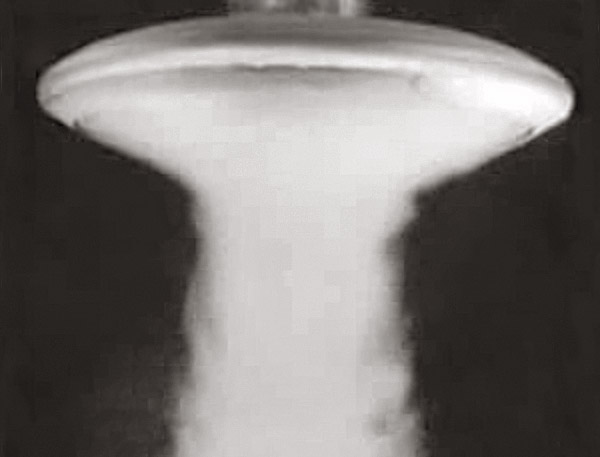
An airstream can go through or around a flying disc. I am very much in favor of an external airstream, because:
- More air mass can go around a disc than through (at the same speed).
- An external airstream can suck secondary air into the airstream, without moving parts (without solid mechanics).
- A path of air through the disc has great negative inpact on the disc's interrieur: less space, even less useful space, and more noise.
|
 |

|
|
John Frost, father of the AVRO-Car, was working in this direction.
Creation of an external airstream
The best propulsion system to create external airstreams with would be one without moving parts. Some options:
- Compressed air, that converts into a fast airstream.
- Pressure/shock waves.
- Electrostatic Propulsion.
Compressed air is easy to get. It can create fast airstreams, even faster than sound. This relative fast air can suck a lot of secondary air into the airstream. Compressed air can be distributed through tubes to where ever it is needed. But there are many disadvantages:
- Noise. Fast airstreams are very noisy, and that is an energy loss. It's caused by the great difference in speed between the gasstream and the ambient air.
- While air is being compressed, it becomes quite hot, and thus has to be isolated to prevent energy loss.
- The tubes that distribute the compressed air have to be strong and isolated (high pressure, heat and pressure waves). This is all together a lot of unwanted mass. Also do these tubes give a lot of friction to the compressed airstream.
Air should be treated (read: accelerated) gently.
A pressure wave travels with the speed of sound, which is about 340 m/s (at sea level under normal conditions). This high speed is easily achieved because this is how fast air wants to move. An obvious disadvantage of "sound propulsion" is the noise, but when using low frequencies (below 20 hz) and ani-sound (opposite waves), the noise polution could be less.
Air can be set in motion in two ways: Continuously and Pulsed.
Cool is how fast a pressure wave travels: Mach 1 (= 1 time the speed of sound). This pressure wave can easily set tons of air in motion! Funny is that when an object has an airspeed of 300 m/s, the pressure wave from it (traveling in the same direction) has a speed of only 40 m/s relative to the aircraft! This can be very useful to VTOL builders.
As all; a work in progress.
Giesbert Nijhuis
2006-06-04
|
|
|