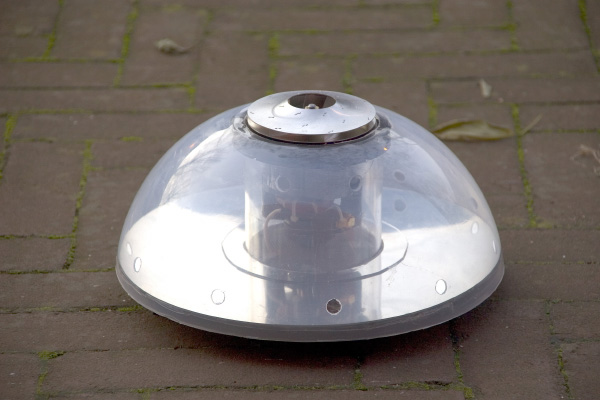
Goal: to see if the Coanda effect works.
Can we produce thrust without using a: wing, rotor, propeller, jet, or rocket?
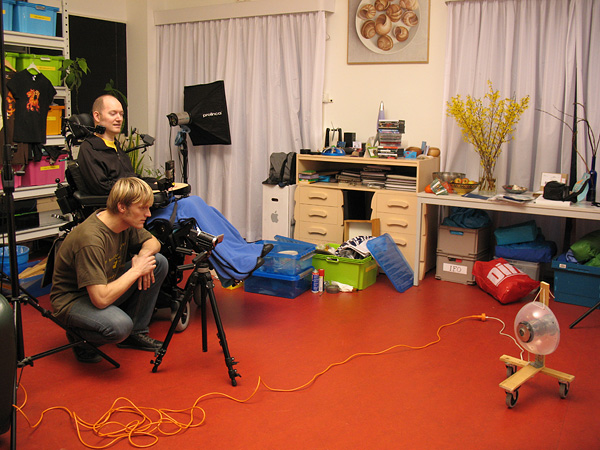
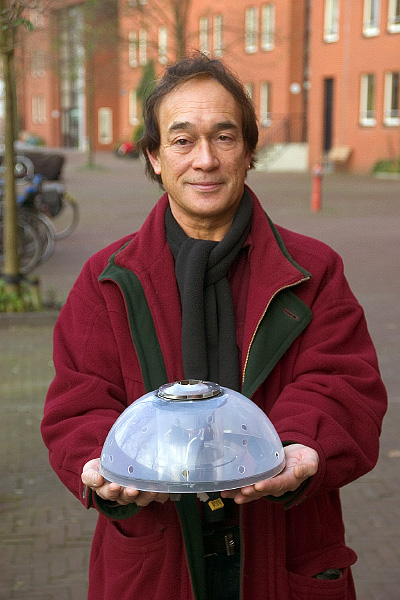
(2004-12-03) This coanda thruster experiment was positive: it produces thrust, but not enough to lift its weight, so that was disappointing. The next test (2010-02-25) gave the following numbers:
290 g thrust, at about 652W, thus 0.44 g per W
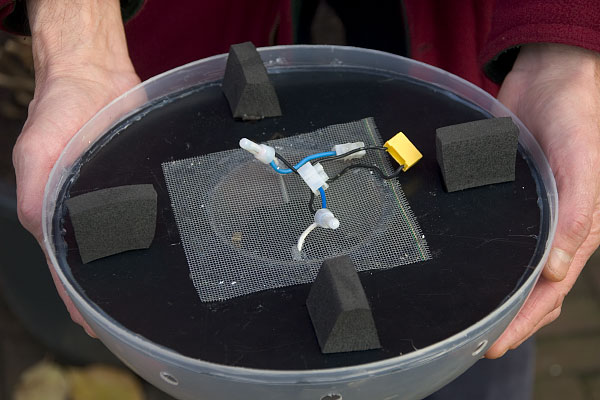
For comparison; a simple turbojet engine will produce thrust of approximately 1.54 g per Watt. This is my first coanda experiment, and the engine is of low quality (cheap vacuum-cleaner). The next model should be more efficient, give more thrust force per energy & weight.
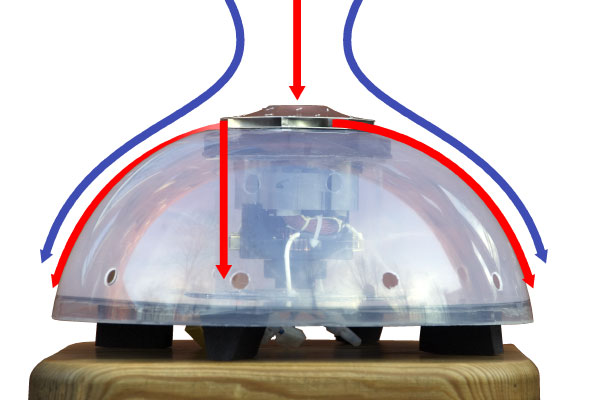
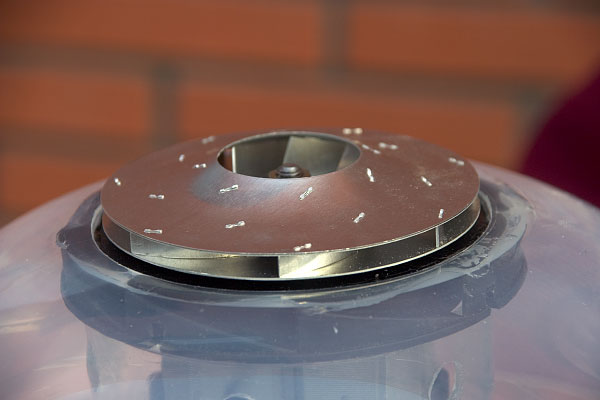
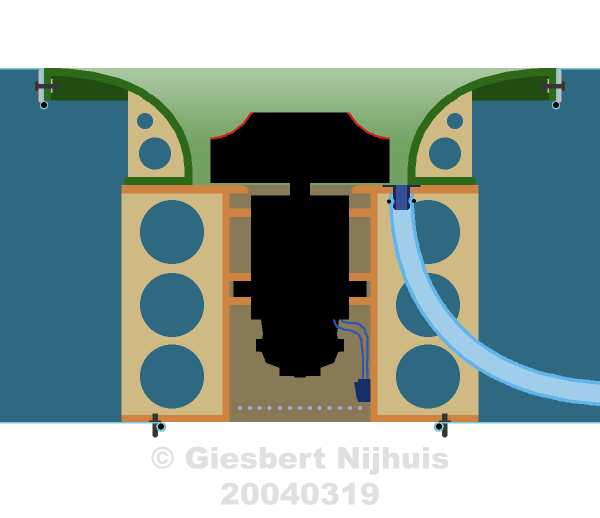
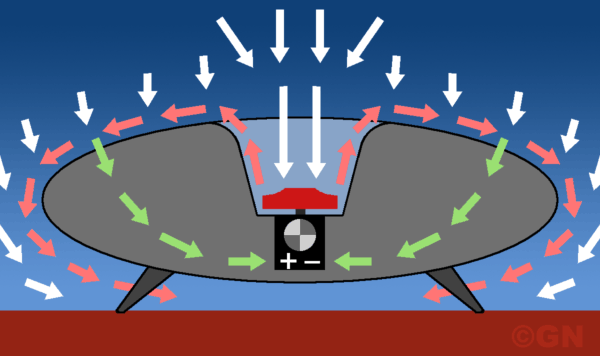
How does this coanda effect thruster work? 1) The centrifugal pump on top accelerates air away from the center, sideways. This causes a lowered air pressure area in the intake, but that's not creating much thrust, because the pressure of the ambient air filles this void easily.
2) The "Coanda effect".
The accelerated air shoots away from the center, in all directions. Would there be no disc under, the jet of air would just go straight and mix with the ambient air. A jet of air in air mixes its velocity with the ambient air. In this case the ambient air is accelerated away from the center by the jet, and the jet is accelerated towards the center by the ambient air. This may sound strange, but there is no such thing as de-acceleration, nor is there "fast air", because speed is relative and not a property of mass.
But there is a disc under the jet. The disc's surface is an obstruction for the ambient air that wants to fill the void, left behind by the air the has mixed with the jet, air that is accelerated away from the center. At first the air between the jet and and the surface is lowered. Next the jet and the disc's surface are being pushed together by the pressure of the ambient air (about 1.033 kg/cm2 at sea level). Because the jet and the surface come closer together, the pressure of the air in between is reduced even more, causing the two to get closer, reducing the pressure more, reducing the distance, reducing the pressure, reducing the pressure, until there is no more space in between, and the jet "sticks" to the surface.
So; because the air pressure on top is reduced by the "sucktion" of the jet, the pressure of the ambient air is pushing more on the bottom than on top of the disc. This difference in force, is the thrust of the coanda effect.
Note: I don't think a jet of air will stick to a surface in the vacuum of space. Or can air molecules pull as well as push?
3) Secondary air, and Newton.
The jet on top of the disc is also in contact with the ambient air there. This air is accelerated by the jet, causing the jet to lose power, and gain weight. From a Newtonian point of view, the air mass is first accelerated sideways in all directions by the centrifugal pump, then accelerated downwards by the Coanda effect. The result is mass being accelerated downwards and thrust in the opposite direction.
There is this rule that it's more efficient to accelerate a big mass a bit than a small mass a lot. That's why rockets are not efficient for lifting crafts, and wide slim wings are. So why not just throw a big airmass down, and forget about the coanda effect? Good question.
Sometimes people choose a rocket for thrust, sometimes a large rotor. Every situation has its best solutions. Sometimes the best solution might be the Coanda effect, like in the case of a disc shaped VTOL craft. Some think the Coanda effect can have a very high VTOL efficiency at zero airspeed. I haven't seen solid proof of that yet.
Thrust and drag
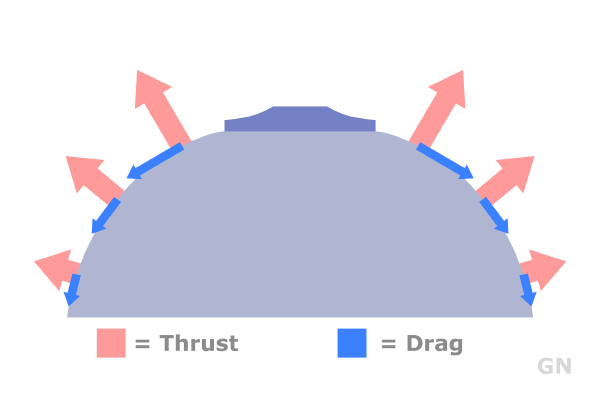
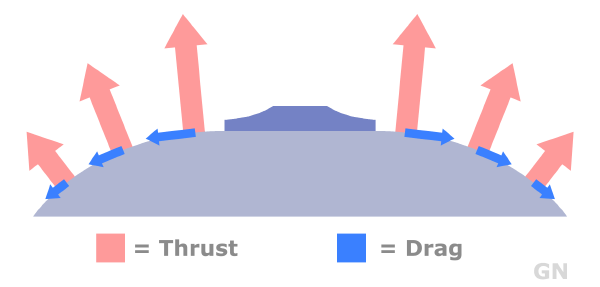
On top there is a lot of thrust going upwards, but further from the center the thrust is going more and more sideways. Thrust going Left + Right together = Zero.
The drag forces are horizontal at first, canceling each other out. But the further from the center the more the drag forces are pointing downwards!
So, it seems more efficient to not curve down all the way, but to stop at about 45 degrees.
How about "vacuum cells"?
An airstream can suck a cell (closed at the bottom) to less pressure.
This is very similar to the Coanda effect, but with less draw because there is less contact between the jet and the solid surface.
How about spinning the whole disc?
When the disc becomes the centrifugal pump, there would be less friction on top between the airstream and the disc. The boundary layer could be used to accelerate the air, just like a Tesla pump. This will also give a lot of gyro-stability.
How about using a high electrostatic charges to to drive the air with?
And could removing a electrostatic charge result in an implosion, causing a low pressure area?
How about an airdriven pump, without moving parts?